Green Finance
Green Loans vs. Green Bonds: What SMEs Should Know
Key takeaways
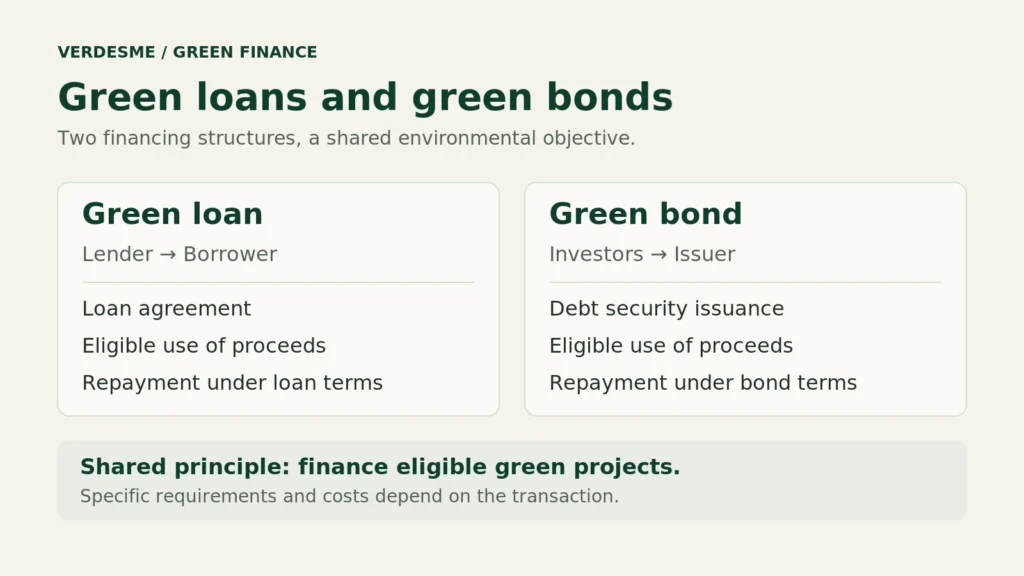
- Green loans are arranged with lenders; green bonds raise debt capital from investors.
- Both use-of-proceeds instruments link funding to eligible environmental activities.
- For many SMEs, a bank loan may be a simpler starting point, but suitability depends on actual costs, financing size and market access.
The difference in plain English
Imagine a company planning to improve the energy efficiency of its factory. It could approach a bank for a loan or, if it has access to the capital markets, raise money through a bond issuance.
The green designation relates to the environmental purpose of the financing. It does not turn debt into a grant or remove repayment obligations.
The Green Bond Principles published by ICMA are voluntary market guidance for credible green bond issuance. Green loans have their own principles, published through the LMA sustainable lending resources.
Comparing the two instruments
| Question | Green loan | Green bond |
|---|---|---|
| Who provides funding? | One or more lenders | Investors purchasing debt securities |
| How is funding arranged? | Loan agreement | Bond issuance under relevant market rules |
| What is the green purpose? | Eligible projects or expenditures | Eligible projects or expenditures |
| What are typical preparation considerations? | Credit assessment, loan terms and project documentation | Issuance documents, advisers and investor disclosure |
| What happens after funding? | Repayment and agreed reporting | Debt servicing and applicable disclosure/reporting |
This comparison describes typical structures, not universal legal requirements. Specific products can differ significantly.
What both approaches have in common
Under the widely used green loan and bond principles, issuers or borrowers need to explain the environmental purpose of the funding, how eligible projects are selected, how funds are allocated and how relevant information is reported. External review may also be relevant depending on the framework and transaction.
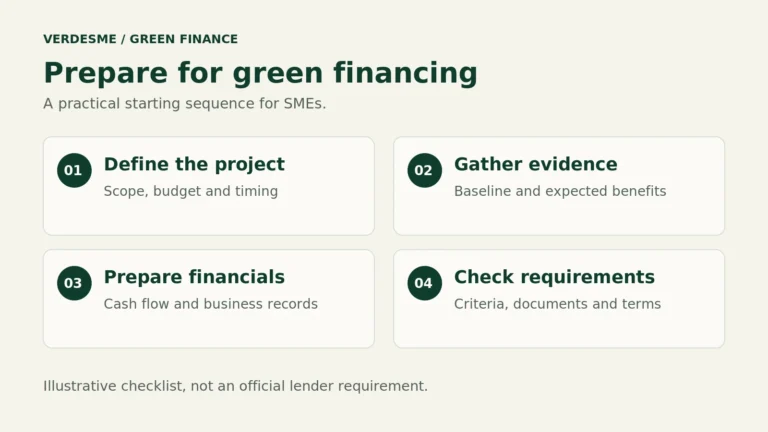
An SME should therefore preserve invoices, contracts, technical evidence and records of expenditure from the beginning. A clear audit trail is useful regardless of the funding route.
Which option is more practical for a small business?
A direct bond issuance can involve fixed costs, legal requirements, investor expectations and ongoing disclosure obligations. A smaller investment may not justify that complexity. Discussing a green loan with an existing bank or other regulated lender may be more practical.
That is not a universal rule. A larger enterprise with recurring financing needs and suitable market access may consider bond financing. Some financial institutions also raise funds through green bonds and use those funds to provide qualifying loans to businesses, so an SME does not necessarily need to issue its own bond to benefit indirectly from that market.
Are sustainability-linked loans the same thing?
No. A sustainability-linked loan generally uses agreed performance targets to incentivise sustainability improvement. Its proceeds need not be restricted to a particular green project in the same way as a use-of-proceeds green loan. Ask which structure the lender is offering and what obligations the business will assume.
Questions to ask before choosing
Compare the financing amount, minimum transaction size, total costs, repayment profile, collateral requirements, environmental criteria and reporting obligations. Ask for a written explanation of any pricing benefit or additional fees.
For a practical documentation checklist, read How to Prepare Your SME for Green Financing. For an introduction to project-level green credit, read Understanding Green Credit: A Practical Guide for SMEs.
Sources & further reading
VerdeSME Toolkit
Bank Matching
Bank Matching is in development. The preview explains its current status.
View the preview