Policy
Vietnam’s Green Taxonomy: What SMEs Need to Know
Key takeaways
- Decision 21/2025/QD-TTg was issued on 4 July 2025 and took effect on 22 August 2025.
- The decision provides environmental criteria and a framework for formal confirmation of qualifying investment projects.
- A project confirmation is not the same as a bank's credit approval or an automatic entitlement to preferential financing.
What is Vietnam’s green taxonomy?
A green taxonomy is a classification framework used to identify activities or projects that meet defined environmental conditions. Vietnam’s Prime Minister issued Decision 21/2025/QD-TTg on environmental criteria and confirmation of investment projects within the green taxonomy. The decision relates to state incentives and support concerning green credit and green bonds.
The official Vietnamese text is the authoritative reference. An English overview can help international readers understand the framework, but it should not replace the applicable Vietnamese legal instruments when determining obligations for a specific project.
Decision 46/2026/QD-TTg, effective 1 November 2026, also provides criteria for identifying green and circular projects and applying environmental, social and governance (ESG) standards. That guidance is relevant to the state interest-support policy for private-sector businesses. This article covers confirmation under Decision 21/2025/QD-TTg. SMEs should check which rules apply to the financing or support programme they are considering before preparing a submission.
What conditions must a project meet?
Article 3 establishes two principal conditions. In simplified terms, the project must meet the applicable environmental-procedure requirements, unless legally exempt, and it must fall within the relevant environmental activities or benefits and satisfy the criteria in Appendix I.
The applicable environmental procedure may involve an environmental impact assessment approval, an environmental licence or environmental registration, depending on the project. An exemption should be supported by the relevant legal basis rather than assumed from the size of the business.
Appendix I sets out detailed requirements by project type. A general description such as “energy saving” or “renewable energy” is not sufficient evidence of alignment on its own.
How does formal confirmation work?
The Government’s official explanation of the decision describes two routes: confirmation by the competent public authority during the relevant environmental procedure, or confirmation by an independent organisation that meets prescribed conditions.
The appropriate route and documentation depend on the circumstances. Project owners should consult the decision, its appendices and current procedural guidance before making an application. Environmental procedures have also been updated through subsequent legal instruments; the applicable forms and authority should be checked for the specific project at the time of filing.
A practical preparation sequence for SMEs
| Step | Suggested action |
|---|---|
| Identify the project | Describe the planned investment and its technical scope |
| Match the criteria | Locate the relevant entry in Appendix I and check its requirements |
| Review compliance | Identify the applicable environmental documentation or legal exemption |
| Assemble evidence | Organise technical data, permits and a clear project explanation |
| Confirm the route | Ask the competent authority or qualified independent organisation about current procedures |
| Discuss financing | Ask the lender which product, evidence and reporting conditions apply |
This is an editorial preparation sequence, not an official application checklist. Do not interpret it as a substitute for the prescribed forms or current regulations.
Does taxonomy alignment guarantee green credit?
No. Confirmation of a project’s alignment and a lender’s commercial credit decision are distinct matters. The decision explains the role of confirmation as a basis for requesting relevant state support, while the decision also addresses application of its framework by credit institutions. A lender may still evaluate creditworthiness, collateral, cash flow and its own product requirements.
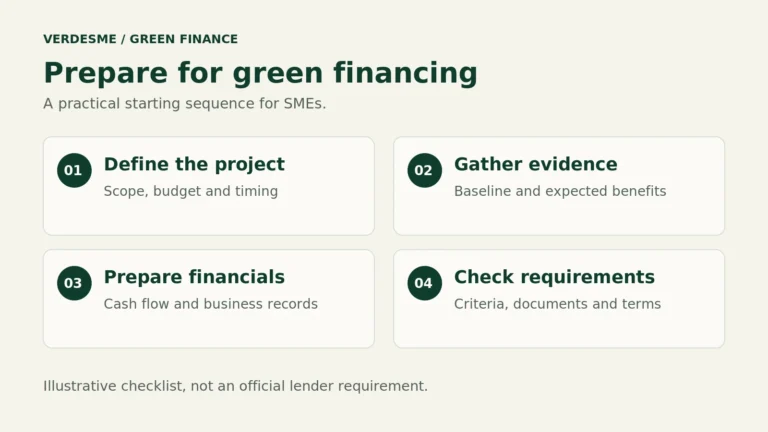
For SMEs, the most useful starting point is to establish which requirements apply before investing in documentation or external verification. See How to Prepare Your SME for Green Financing for a practical financing preparation checklist.
Sources & further reading
- Prime Minister of Vietnam, Decision 21/2025/QD-TTg — official Government document entry, issued 4 July 2025, effective 22 August 2025
- Government Official Gazette, Decision 21/2025/QD-TTg
- Government News, Environmental criteria and confirmation of investment projects under the green taxonomy, 4 July 2025 (Vietnamese)
- Prime Minister of Vietnam, Decision 46/2026/QD-TTg, effective 1 November 2026
- Ministry of Agriculture and Environment, Circular 09/2026/TT-BNNMT, updated environmental procedure forms
VerdeSME Toolkit
Project Screening
Project Screening is in development. The preview explains its current status.
View the preview