Green Finance
How to Prepare Your SME for Green Financing
Key takeaways
- Start with the investment plan and a baseline, not a list of attractive loan products.
- Organise environmental and financial evidence separately, then connect both to the project.
- Confirm the lender's actual requirements before paying for studies or certifications.
Step 1: Define the investment
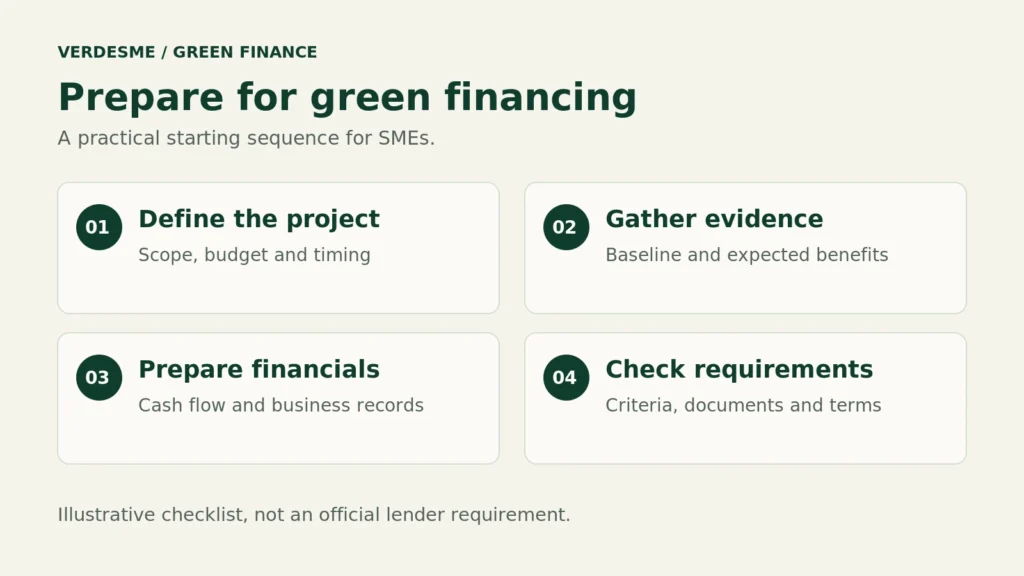
Write a one-page project brief. Explain what will change, why the business needs the investment, where it will take place and when it can be completed. Include estimated expenditure, financing required, proposed suppliers and the expected operating lifetime.
Keep the budget separated into identifiable cost categories. A lender may need to establish which expenses can be funded under a particular product. Do not assume that all expenditure associated with a project is eligible.
Step 2: Establish the environmental baseline
Identify a metric that reflects the proposed improvement. For an energy-saving project, gather electricity bills or meter readings and operating records. For a water-efficiency project, collect consumption records and relevant production data.
Make the baseline period and measurement boundaries clear. If output levels change, comparing total consumption alone may give a misleading picture. Consider an appropriate intensity measure, such as electricity per unit produced, alongside absolute consumption.
Keep estimates and actual measurements clearly labelled. A supplier’s predicted performance is useful evidence, but it is not a verified operating result.
Step 3: Prepare the financial case
Develop a cash-flow forecast that includes capital costs, operating costs, potential savings, maintenance and repayments. Test a conservative scenario in which equipment savings are lower or installation is delayed.
The IFC financing application guidance illustrates the kinds of project and feasibility information an institution may seek. IFC’s own requirements are not a universal checklist for SME bank lending.
Step 4: Create a financing evidence file
Use the following suggested checklist as an internal preparation tool. It is not a legally prescribed list or a guarantee of eligibility.
| Document group | Suggested evidence |
|---|---|
| Business identity | Registration and authorised representative details |
| Financial capacity | Recent financial statements, borrowing obligations and cash-flow forecast |
| Project plan | Supplier quotations, budget, scope and implementation timeline |
| Environmental evidence | Baseline data, technical specifications and estimated outcomes |
| Compliance | Applicable permits, registrations or documented exemptions |
| Monitoring | Proposed metrics, measurement frequency and responsible staff |
For each item, record its owner, date, status and the next action. Use a secure internal storage location. Avoid sharing confidential records with unverified intermediaries.
Step 5: Check criteria before applying
Ask the lender which environmental classification or taxonomy applies, whether a formal project confirmation is needed, what evidence must be provided and whether an external review is expected.
If operating in Vietnam, review Vietnam’s Green Taxonomy: What SMEs Need to Know for an introduction to Decision 21/2025/QD-TTg. If considering management-system certification, review Environmental Standards and Certifications for SMEs before committing to certification expenses.
Step 6: Compare the financing offers
Ask about interest rates, fees, collateral, loan maturity, repayment schedules, eligible spending and reporting obligations. Compare offers against your expected cash flow and project timeline, rather than choosing based only on an advertised green label.
The objective of this preparation process is to make the first financing discussion more productive. It is not to produce a universal readiness score or to predict the lender’s decision.
Sources & further reading
VerdeSME Toolkit
Gap Analysis
Gap Analysis is in development. The preview explains its current status.
View the preview